Refrigerator Repair
Frost on the Back Wall That Comes Back Within a Week
5 min read
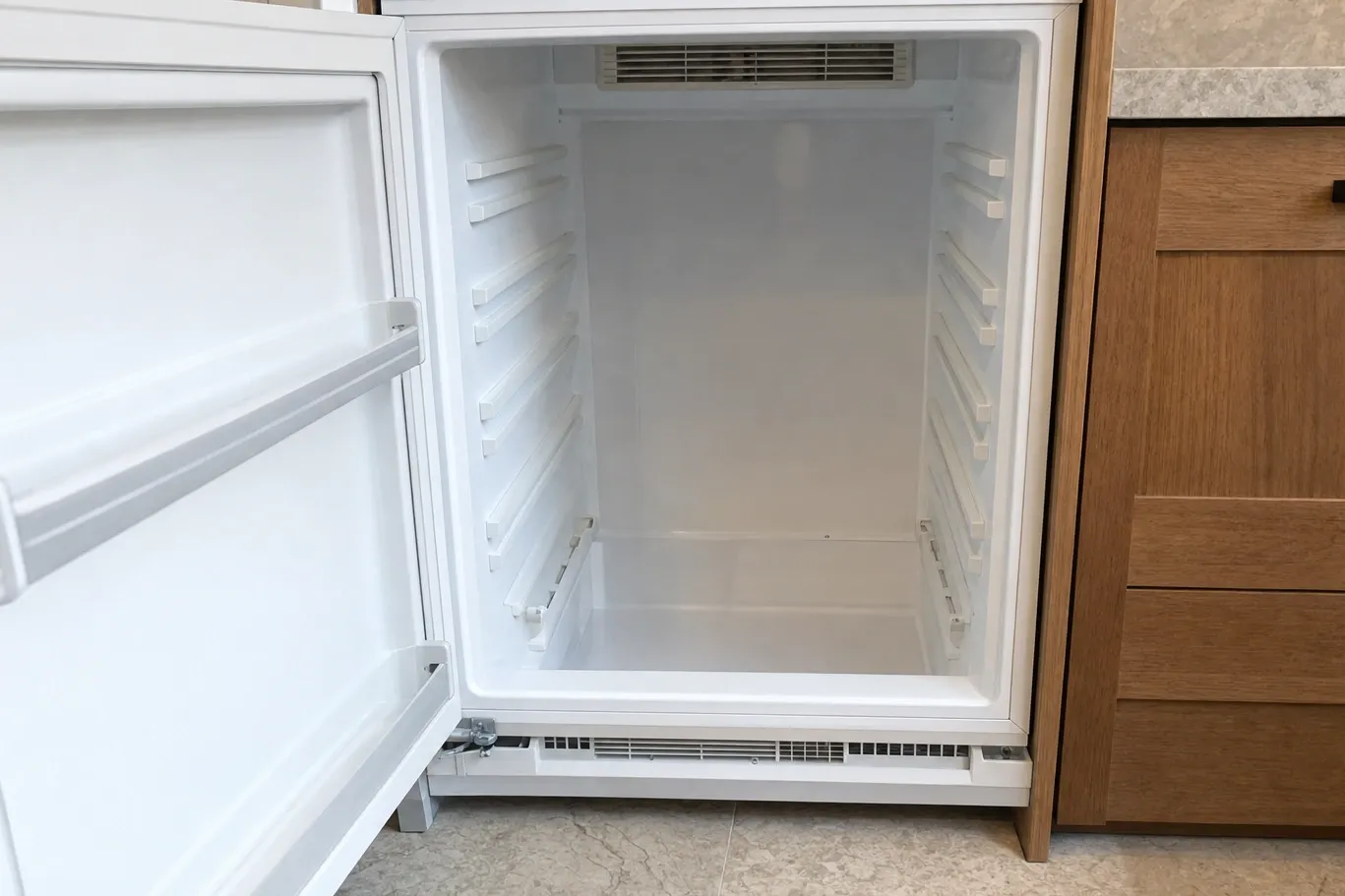
There is a specific version of this complaint that is worth treating differently from general icing. Not “there is frost in the freezer”, which can mean a dozen things, but: I cleared all of it, and within a week it was back in the same place. That detail narrows the diagnosis more than anything else you could tell a technician on the phone, because it rules out almost everything except the defrost system.
Why frost returns rather than simply accumulating
Every frost-free refrigerator makes ice on its evaporator continuously. That is not a fault; it is how it works. Air is drawn across a coil colder than the compartment, moisture in the air condenses onto the coil and freezes, and the now-dry cold air is pushed back into the cabinet. Left alone, that coil would ice solid in a matter of days and airflow would stop completely.
So the appliance clears it, on a schedule. Several times a day the compressor stops and an element beside the coil warms it just past freezing. Whatever had built up turns back into water, leaves through a small tube, and finishes in a shallow tray sitting on top of the compressor, where the heat rising off it takes the water away. Then cooling starts again. You never see any of that. You only see the result, which is a coil that stays clear and a cabinet that holds its temperature.
When frost comes back within days of being cleared, one of the steps in that sequence is not happening. The ice is still being made — that part never stops — but it is no longer being removed. Clearing it by hand does the machine’s job for it once, which is exactly why the cabinet behaves for a week or two afterwards and then does the same thing again.
The three parts that make up a defrost system
There are not many candidates, which is the good news:
The heater. A resistance element clamped to or threaded through the evaporator. It either has continuity or it does not, and testing it is a two-minute job with a meter. A failed heater is the most common single cause of this symptom, and the part is inexpensive.
The terminator or thermostat. A safety device that stops the heater once the coil has reached a temperature indicating the ice is gone. When it fails open, the heater never gets power at all, and the symptom is identical to a failed heater. This is why both get tested rather than one being assumed from the other.
The control that decides when to defrost. On older equipment a mechanical timer, on current equipment the main control reading a sensor. If it never calls for a defrost cycle, everything downstream can be in perfect condition and the coil still ices up.
The honest way to separate these is to force a defrost cycle and stay and watch it. Not start it and come back later — watch it, with a meter on the heater circuit, because a cycle that starts and then terminates ten seconds in looks from the outside exactly like a cycle that ran properly.
The drain is the one people forget
There is a fourth failure that produces the same complaint and is not a defrost component at all: the drain tube.
The defrost cycle works perfectly, the ice melts as designed, and then the water has nowhere to go. A drain tube blocked with debris or, more often, plugged with its own ice means the melt water backs up, refreezes at the bottom of the evaporator area, and builds a sheet that grows a little with every cycle. Eventually it reaches the fan blade, and now you have a scraping noise on top of everything else.
The tells are worth knowing, because they are visible without a meter:
- ice building at the bottom of the compartment or under a drawer, rather than evenly across the coil
- water appearing under the crisper or running out of the door when it is opened
- a ridge of ice with a smooth, run-and-refrozen look to it rather than the fluffy texture of frost that formed from air
A blocked drain is a cheap repair and a clearing job, but it is not one that gets fixed by replacing a heater — which is what happens when the frost is treated as evidence of one fault without anybody looking at where the water went.
What you can check in ten minutes
Before booking anything, these are worth doing:
- Look at where the ice is. Even coverage across the back wall points at the defrost system. Ice concentrated at the bottom or under a drawer points at the drain. Ice heaviest near the door points at the seal.
- Feel the seal rather than looking at it. With the door shut, move the back of your hand slowly around the frame an inch out from the gasket. Where the seal has given up you will feel cold air moving against your skin; where it is still doing its job you will feel nothing. Gaskets fail in patches, so go all the way round rather than checking one corner and stopping.
- Watch what happens when the door is opened. A rush of visible fog at a door that was only just closed suggests warm air is getting in continuously.
- Note whether the cabinet is still holding temperature. A cabinet that is icing up but still at temperature is early in this fault. One that has started to run warm has iced enough to block airflow, and it will not recover on its own.
- Do not chip at it. The evaporator and the drain path are aluminium and plastic, and a screwdriver used as an ice pick turns a cheap repair into an expensive one.
When it is the door and not the defrost
Occasionally the defrost system is entirely healthy and simply outmatched. A seal that has gone hard with age, a hinge that has dropped, or a door that is being held fractionally open by a container inside will admit warm, humid air continuously. The defrost cycle runs on schedule and clears what it can, but more ice arrives between cycles than the cycle can remove.
The pattern is different enough to be worth checking first: frost heaviest near the door rather than the back wall, condensation on the outside of the cabinet near the seal, and a compressor that runs far more than it rests. All of that is cheap to test and cheap to put right, and it is the first thing to rule out before anyone starts pricing components.
Follow-ups
- Isn't some frost normal in a freezer?
- A light, even dusting that never really grows is normal — that is moisture from the air condensing and being removed on the next defrost cycle. What is not normal is a solid sheet, a ridge that thickens week by week, or ice you have to chip. Those mean the ice is not being removed, which is a system that has stopped completing its job.
- I defrosted it manually and it was fine for a fortnight. Is it fixed?
- No — that is the fault confirming itself. Manual defrosting removes the accumulated ice and resets the clock, so the cabinet works normally until the ice builds back to the point where it blocks airflow again. The interval between defrosts is roughly how long you have before it happens once more.
- Could it just be the door seal?
- It can be, and that is worth ruling out first because it costs nothing. A seal that has gone hard or a door sitting slightly proud lets warm humid air in continuously, which loads the evaporator faster than the defrost cycle can clear it. The tell is frost concentrated near the door rather than spread across the back wall.
- Is this an expensive repair?
- It is usually one of three inexpensive components — a heater, a sensor or a blocked drain tube — rather than anything in the sealed system. The diagnosis is what takes the time, because the honest way to do it is to force the cycle and watch it through rather than infer it from the frost pattern.